
Storage tank terminals and their role in energy value chains
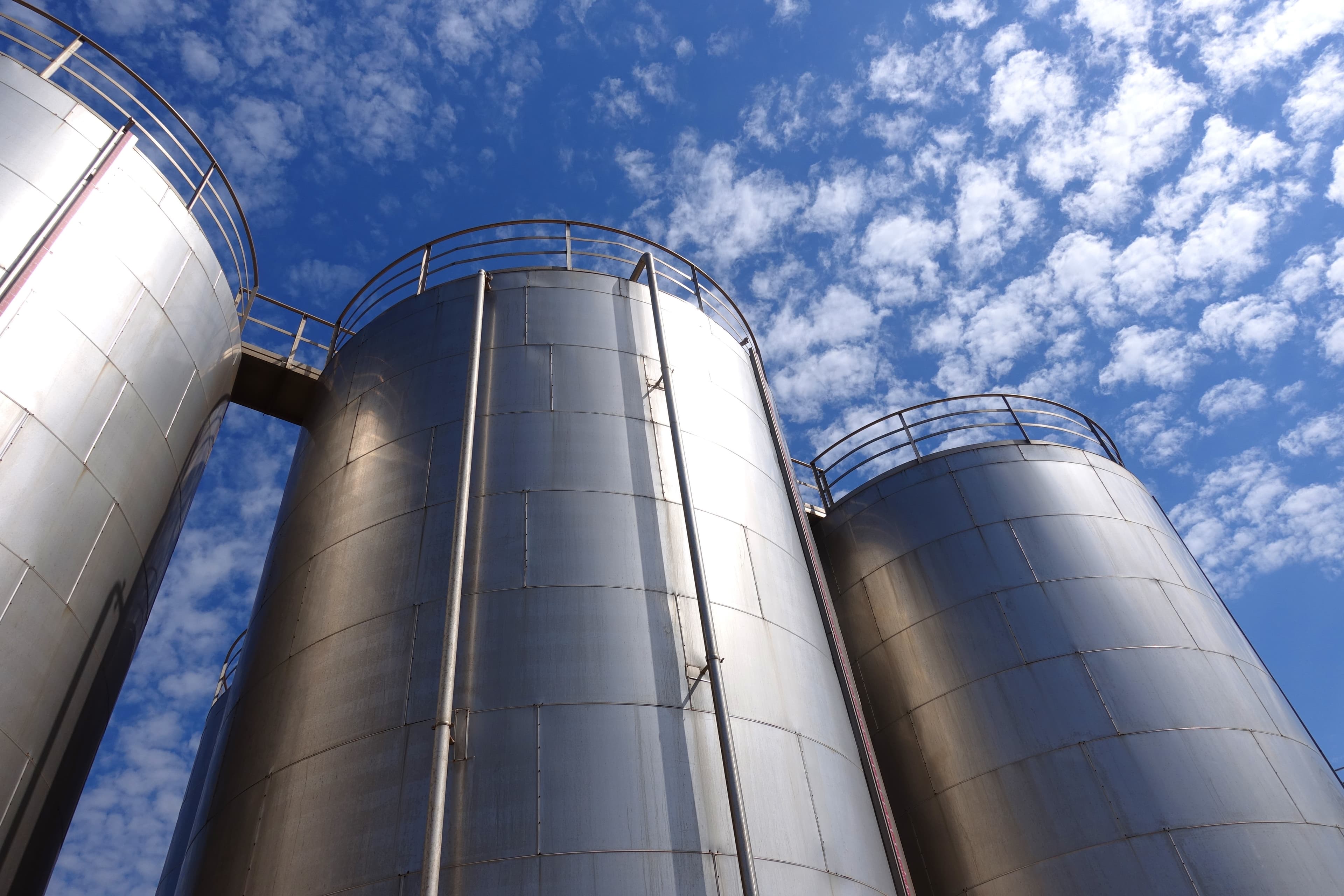
Storage tank terminals help facilitate structural trade flows between net exporting and net importing countries, particularly for liquid energy products. Main role for storage facilities include:
Store and handle products for imports, exports or domestic distribution, including break-bulk and build-bulk operations.
Maintain supply chain flexibility and reliability by supporting consolidation and distribution of products.
Assist governments in building strategic stockpiles in line with international agreements (i.e. International Energy Agency (IEA) member countries need to ensure at least 90 days net import of oil inventories.
Dedicated supply and storage of feedstock and products through integration into production plants
In addition to basic storage, these facilities also offer value-added services such as product blending, inter-tank and pipeline transfers, marine and port services, product discharge and loading, ship-to-ship transfers, as well as specialist product treatments including heating and additive injection.
Storage tank terminals typically operate under three business models:
Hub terminal - Supports trading and transshipment hubs situated along major shipping routes, including the US Gulf Coast in North America, Amsterdam-Rotterdam-Antwerp in Europe, Fujairah in the Middle East, and Singapore in Asia Pacific. These terminals primarily store clean and dirty petroleum products and typically also provide blending services to fulfil destination-specific product specifications, enhancing the commercial value and marketability of the stored products.
Industrial terminal - Primarily offers long-term storage of feedstocks, such as ethylene and propylene, as well as products for plants in refining and petrochemical complexes. These terminals may also contain gas storage, including LNG used as a fuel supply for gas-fired power plants, and LPG used as a co-feedstock for petrochemical crackers. Industrial terminals are typically integrated into the plants’ supply chain, with pipeline connections to connecting terminals and plants, ensuring reliable and optimised flows.
Distribution terminal - Provides break-bulk services for products headed to nearby demand centres via land-based distribution networks or short-distance marine transport such as barges. The product portfolio includes refined oil products, general and specialty chemicals, base oils and lubricants.
Storage tank terminals can additionally be classified into three different ownership models – independent, captive, and semi-captive:
Independent - Operated by service-focused companies that own and manage storage exclusively for third-party customers. These operators typically benefit from stable cash flows and limited exposure to commodity price volatility, as they do not take ownership of the stored products.
Captive - Owned by companies that utilise the storage facilities solely for internal purposes and do not offer capacity to third parties.
Semi-captive - Owned by companies that use part of the storage capacity for their own requirements, while leasing surplus capacity to third parties on a short-term basis.
Independent Storage Operator Landscape
Of the three ownership models, independent storage operators provide neutral, third party infrastructure to potential customers without assuming ownership of the products or competing with them.
For independent storage operators, the majority of revenue, typically around 80 to 90 percent, is generated from storage rental contracts. These contracts vary from short term “spot” rentals for periods such as one week, to long term “contracted” rentals for periods of several years. Although spot rentals can provide higher rental fees, longer-term contracts are critical to independent storage operators as they provide long term, secure cash flows, allowing operators to more effectively plan the future of their business.
The remaining revenue streams are derived through provision of ancillary services such as blending, jetty services and heating. Most independent storage operators would typically pursue a business model based on serving a steady group of large producers and refiners, while retaining some excess capacity to capture spot demand from traders.
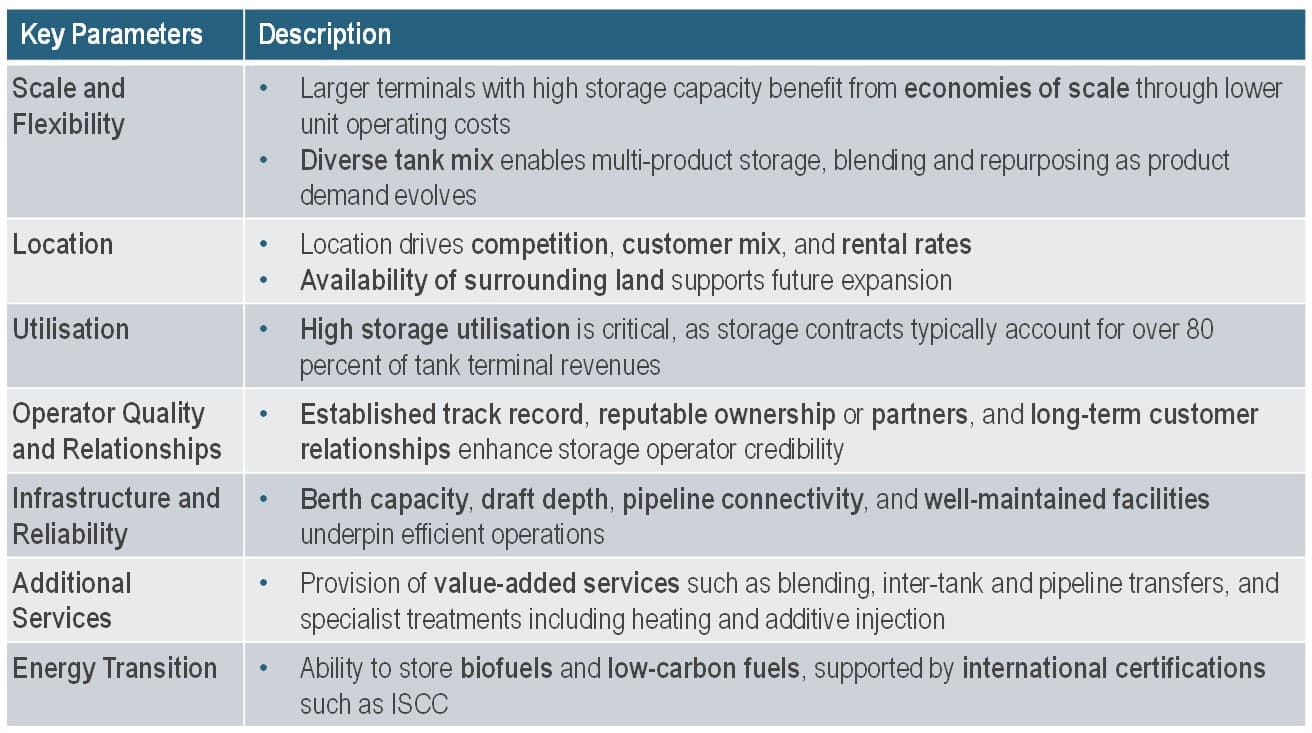
Independent storage is a commodity-type business where differentiation is difficult. Key parameters that may indicate competitive advantage of an operator are listed in Table 1 below:
Table 1 Key Parameters of Competitive Advantage of Independent Storage Operators
Storage Demand Drivers
Oil product storage business is supported by fundamental dynamics of the oil industry, including structural imbalances between production and demand in refined product markets, as well as the need for supply security.
Oil exploration and extraction is largely concentrated in the Middle East, the United States and Russia, while oil demand is located in Western Europe and Asia, particularly China.
This geographic mismatch creates substantial global trade, driving demand for storage at multiple points along the supply chain.
As a result, the demand for storage capacity is driven primarily by import and export trade flows, rather than energy price movements.
Demand for storage is also driven by fragmented end-markets, where smaller market needs are met by break-bulk distribution, as well as by differing fuel specifications and blending requirements.
Tightening environmental regulations, such as stricter marine emission standards and varying sustainable aviation fuel (SAF) blend mandates, are similarly increasing the need for blending activities and segregated storage of oil products.
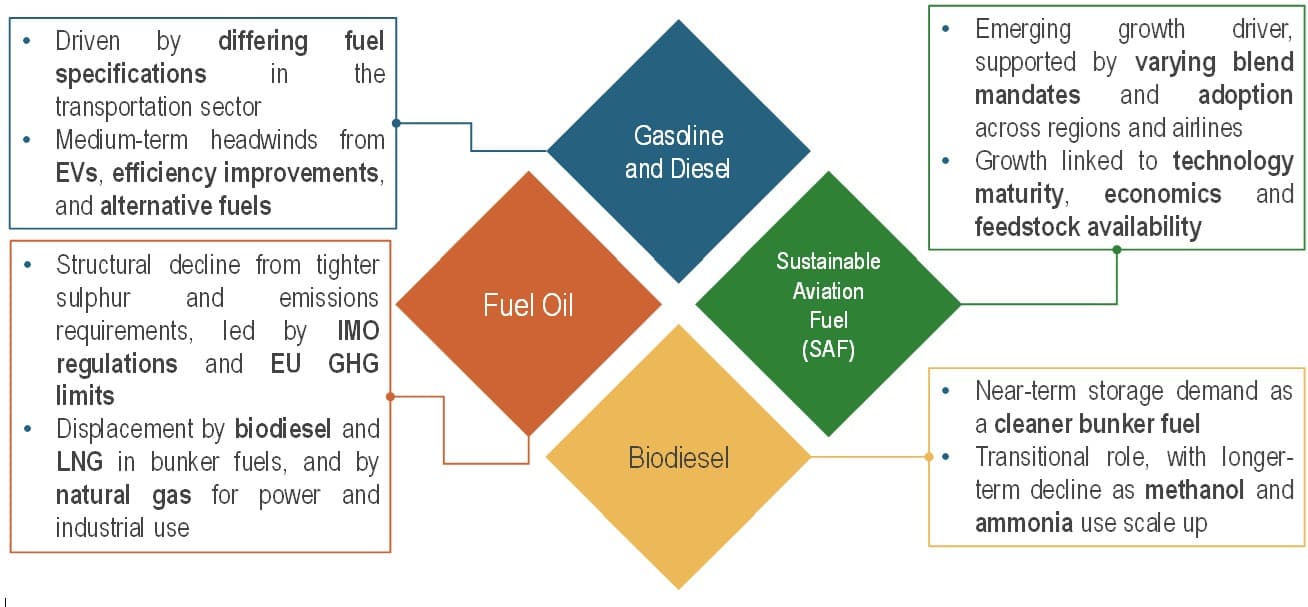
Product-level storage demand is increasingly shaped by decarbonisation policies across transportation, shipping, and aviation sectors. Figure 1 below presents a product level overview of storage demand trends, highlighting potential changes in consumption and corresponding storage requirements for selected products over time, including gasoline, diesel, fuel oil, SAF and biodiesel.
Figure 1 Product-Level Storage Demand Trends by Fuel Type
The Author...
Christopher Ho, Senior Analyst
About Us - FGE NexantECA is the leading advisor to the energy, refining, and chemical industries. Our clientele ranges from major oil and chemical companies, governments, investors, and financial institutions to regulators, development agencies, and law firms. Using a combination of business and technical expertise, with deep and broad understanding of markets, technologies, and economics, FGE NexantECA provides solutions that our clients have relied upon for over 50 years.
Contact a member of our Research team to find out more